
The story of the Cardio Rebounder: from a cup of tea to a revolutionary patent - by Sebastiano “Bastian”
Some time ago I had read a comment on Facebook where the origin of the Jump Board was attributed to Joseph Pilates: I knew it was incorrect so I did some research and with the help of Marjolein this is what I learned.
The other “mistake” I often read is to consider the Jump Board similar, better or worse than the Cardio Rebounder. They are two different experiences. Neither one was an inventions of Joseph Pilates, but both, when used properly, interpret the fundamentals of Pilates in wonderful ways.
It was one of his students, Eve Gentry in the 1970s who invented the Jump Board, after Joseph’s death.
Eve was born in 1909 in California. She devoted herself from an early age to ballet, folk, ballroom, and modern dance. Before turning 20 she moved to New York City, where she began her dancing career.
After years of dancing, Eve began to suffer from chronic back and knee problems: she sought help from Joseph Pilates, famous at that time among New York City’s professional dancers. A short time later she became one of his faithful teachers and collaborators.
In 1955 Eve underwent a total mastectomy, which involved the removal of her pectoral muscles. After the surgery she was unable to lift her arms, which could have marked the end of her dancing career. Within a year, with the help of Joseph and Clara, Eve was able to regain full mobility in her arms and upper body! After recovery, Eve continued to work with Joseph for another 10 years.
In 1967 Joseph Pilates died and in 1968 Eve moved to New Mexico, where she founded her own dance and Pilates studio. In the early 1970s she had the first prototype of the Jump Board, which she used in her studio to train dancers to jump better and help them rehabilitate after injuries: the Jump Board took advantage of the absence of gravity and postural imbalances, provided by horizontal training. In fact, dancers could use the impact of the Jump Board to simulate the floor: its rigidity and stability helped them in their ankle articulation and strength.
During those years Eve was also in contact with St. Francis Hospital in California, where the first Pilates-based rehabilitation program in the medical setting was initiated: it is believed that there was a collaboration between Eve and and the hospital in the Jump Board project.
It’s time for the 80s and it is important to remember the historical context. In 1982 Jane Fonda launched her first workout video, Aerobics became a popular training method and fitness began to be commercialized. “No Pain No Gain” became a popular concept albeit diametrically opposed to the Pilates method: despite this and the craze for very restrictive diets, Americans became more and more obese. Pilates however continued to expand whilst remaining an élite, because of the cost of classes and machines: to the point that it became one of the secrets of Hollywood stars, without forgetting its connection to the dance world.
In 1991 Eve Gentry founded with Joan Breibart, a former student of Carola Trier (another Pilates student who had opened a studio in New York), the Pilates Method Institute in Santa Fe.
In 1995, Marjolein, after her famous accident during a morning run, turned for her rehabilitation to this studio (where she also used the Jumpboard) upon the recommendation of her orthopedist. Marjolein was astounded by the results: not only was she able to heal her injuries but she discovered the profound way in which reformer Pilates changed her body compositionally as well as in how she moved. It became very clear that to her the reformer far surpassed the benefits of traditional fitness training. Classes were expensive and out of reach for most people: so she set about to make the reformer affordable and accessible.
Between 1996 and 1997 there was a lot of buzz in the professional world of Pilates. Marjolein, after studying with Romana Krysanowska, a former student of Joseph Pilates, collaborated with Stamina Products to produce the first affordable and user friendly home reformer, named it the Pilates Performer, and it sold out in minutes on QVC.
The Pilates Performer was not only sold on QVC, but also at the Pilates Inc. owned studio where Romana served as didactic partner and director of the training program. She also featured the Performer in her book "The Pilates Method of Body Conditioning": a reference text on the main Pilates exercises.
Marjolein recorded several videos with her supervision, also using the other equipment invented by Joseph, such as the Chair, the Magic Circle, the Box and Pole, the Spine Corrector and the Small Barrel.
Marjolein was a runner who believed in the benefits of cardiovascular training and recognised it was missing from Reformer Pilates. In 1999 she suffered her first foot micro fracture and was advised to stop high impactful running. She set out to find something she could do cardiovascularly without stressing her feet. She remembered the Jump Board but despite the horizontal position, Marjolein still found the impact too strong, even in the padded version. She felt she was almost close to a solution, but needed a simple and innovative idea.
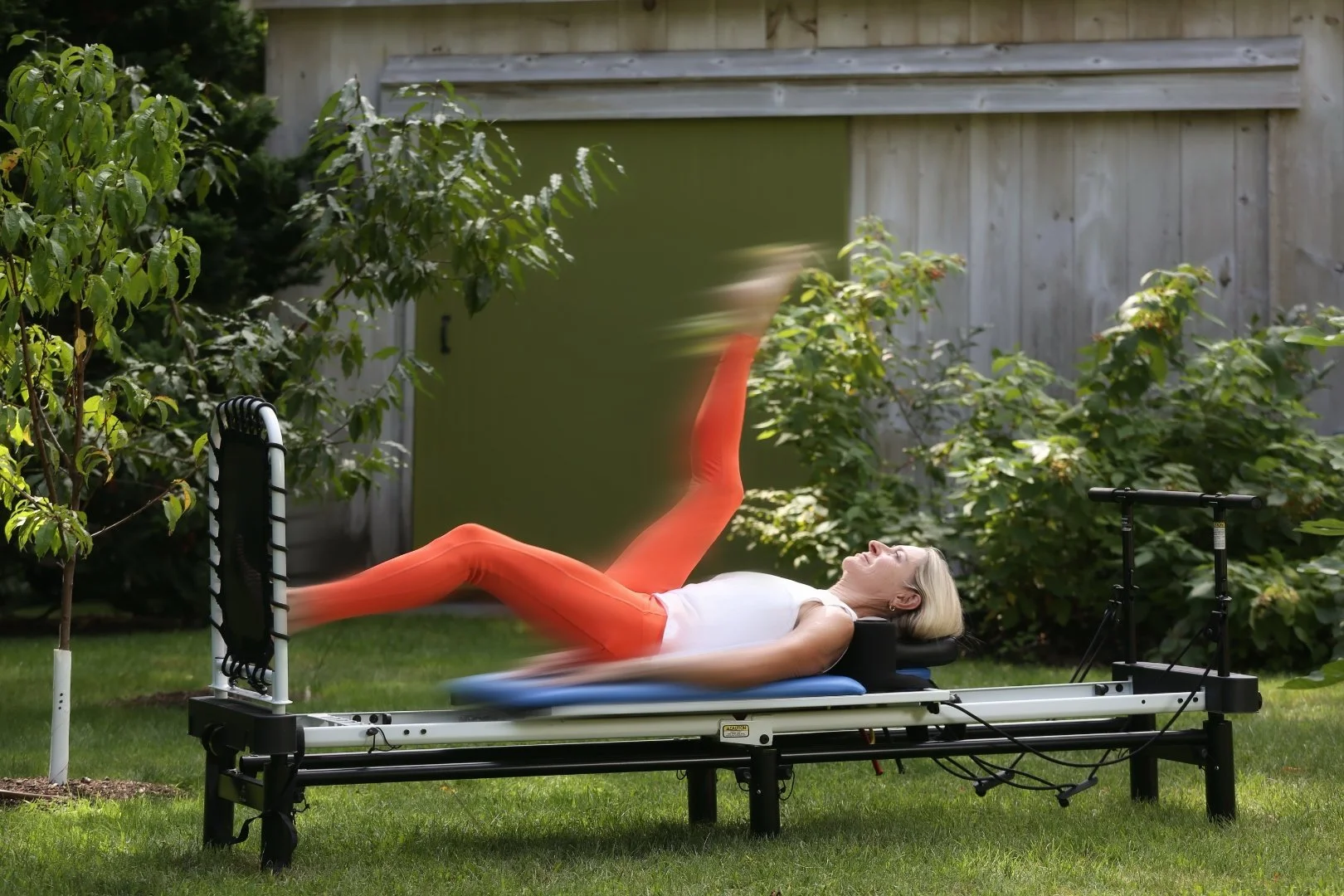
One day, while sipping her favorite English black tea, she got the inspiration to replace the rigid Jump Board with a trampoline, which might absorb the impact. The Cardio Rebounder was developed, patented and tested. It proved to become the missing piece: the benefits of cardiovascular exercise with significantly reduced impact on your spine, organs and joints. Clinical observations and pilot studies supported the invention, showing that you could expend energy effectively whilst lying on your back and that, with reduced tension, you could engage your abdominal muscles and simultaneously train your core.
Compared to the Jump Board, the Cardio Rebounder worked well, even for deconditioned, untrained people. It was gentle yet effective: the elastic surface compensated for errors, making it the perfect option for all fitness levels and ages, even for those with weaker joints.
The Cardio Rebounder became the perfect companion to the foldable homer reformer, which fit in even the smallest of spaces: thanks to its simple structure (a sturdy steel frame, a light mesh that replaces wood and padding, and the signature bungee cords).
Aeropilates was born: a portable and foldable home reformer with a light weight rebounder easy to insert, remove, and handle. Less cumbersome and more fun than the heavier and bulkier Jump Board. Overweight and less strong people could finally easily enjoy a cardio workout whilst also benefiting from a classic Pilates workout to improve strength and flexibilty.
The first AeroPilates machine including the rebounder was launched in 2000’s. Studies begun to be run in collaboration with several universities to gain a better and scientific understanding of its effectiveness. The results showed measurable improvements: with the same amount of moderate effort at a constant perceived intensity on a professional treadmill or elliptical, training with the Cardio Rebounder allowed one to expend energy while also engaging multiple muscle groups at the same time, without the impact on the joints; but it also allowed movements impossible in the upright position that made this new exercise more fun and complete.
It was the perfect ally for that low-intensity workout in what is commonly referred to as the “fat-burning zone” — a steady, moderate intensity where the body can rely more on fat as a fuel source. In the studies, those who combined a steady Aeropilates workout with a balanced diet were able to improve weight management while also improving tone, strength, and flexibility.
Aeropilates, thanks to the Cardio Rebounder, became an enhanced version of classical Pilates because it also included cardiovascular activity, transforming the reformer into a mini home gym, suitable for all ages and training levels, with an easy, accessible and fun method!
What Marjolein may not have known is that it would contribute to redefining how many people approach low-impact, full-body training.
*The history of the Shuttle CMC began around the 1960s as a device to be used on space stations to prevent the cardiovascular deconditioning of astronauts. The initial project was abandoned, but its inventor, Gary Graham, revived it, patented it in 1987 and launched it on the market in 1991.