
There is a muscle deep inside your body that most people have never heard of and almost everyone has tightened without knowing it. It is called the psoas, pronounced so-az, and once you understand what it does, where it lives and why it matters so profoundly to everything from your posture and back pain to your emotional wellbeing, you will never stop thinking about it.
Since my accident in Santa Fe in 1995 when a car hit me while I was bending down to tie my shoe, I discovered, in the most dramatic possible way, exactly what it feels like when this muscle is forced to do a job it was never designed to do alone.
The psoas major is the deepest muscle in our core. It originates at your lumbar vertebrae, and runs forward and downward through your pelvis, crossing your hip joint and attaching to the lesser trochanter at the top of your femur.
It is the only muscle in the human body that directly connects your spine to your leg and that single anatomical fact explains almost everything about why it matters so much. When your psoas is healthy, balanced and properly lengthened it supports your lumbar spine from the inside, creates genuine stability through your entire trunk and allows the free, full range of movement that a healthy hip requires. It is the architectural keystone of your upright posture.
When your psoas is tight, shortened or imbalanced and in most adults living modern lives it is all three, the consequences ripple upwards and downwards through your entire body.
Your psoas contracts in response to two things: sitting and stress but sitting is the more obvious culprit. When you sit, your hip is held in a flexed position and your psoas, which is a hip flexor, remains in a shortened state for the entire duration. One hour of sitting tightens it measurably but eight hours of sitting, the reality for many people in desk jobs, leaves it in a state of chronic contraction that does not fully release when you stand up. Over weeks, months and years this chronic shortening becomes the default state and the muscle gradually loses its ability to lengthen fully.
Stress, however, is the less obvious but in some ways more significant culprit. Your psoas is directly involved in every fight or flight response. When your nervous system perceives a threat, real or imagined, your psoas contracts to curl you into a protective fetal-adjacent position; knees towards your chest, spine curved and your body braced. In a genuine emergency this is a brilliant survival mechanism but in a life of chronic low-grade stress, where the threat is never physical and the all-clear signal never quite arrives, the psoas stays contracted. It holds the tension of everything you have not resolved stores the anxiety you have pushed through, the grief you have not fully felt and the years of too much strife and not enough rest.
There is a reason why body-oriented therapists, somatic practitioners and experienced Pilates teachers all say the same thing: the psoas is where we store our emotions.
The consequences of a chronically shortened psoas are wide-ranging and easy to misattribute to other causes.
Lower back pain is the most common and most direct consequence. When your psoas is tight it pulls your lower back forward and downward, compressing the discs and facet joints and creating the characteristic ache of lumbar tension. Many people who have been told they have a disc problem or lumbar degeneration actually have a psoas problem that is compressing and stressing those structures.
An Anterior pelvic tilt, where the front of your pelvis drops and your tailbone lifts, is almost always partially driven by a tight psoas on one or both sides. This postural pattern creates a pronounced lower back curve, pushing the belly forward and throwing your entire spinal alignment into compensation from the ground up.
Hip flexor tension and restricted hip extension affects your gait, your stride length and your ability to fully extend your hip behind you when walking or running. A tight psoas literally shortens your step.
Pelvic imbalance is one of the most important and most overlooked consequences of a psoas that is tighter on one side than the other. Because the psoas attaches to the pelvis on each side independently, asymmetry in its tone creates a rotational force on your pelvis; one side pulled forward and down, the other side relatively higher and more posterior. This asymmetry then travels upward through the spine, creating compensatory curves and rotations that can eventually affect your shoulders, neck and even your jaw.
In Aeropilates we strive for balance between your two sides. A psoas that is tight on both sides creates compression, a psoas that is tight on one side and less so on the other creates rotation and rotation, sustained over time, is what leads to the scoliotic patterns, hip misalignments and one-sided back pain that so many women develop in midlife and beyond.
Before we get to the reformer work, here are three things you can do anywhere, anytime, to begin releasing your tight psoas.
The Supine Release
Lie on your back on a firm surface with your knees bent and your feet flat on the floor, hip-width apart. Allow your lower back to soften toward the floor without forcing it. Stay there for two to three minutes, breathing slowly and deeply into your belly, allowing gravity to do the work. If you feel a gentle ache or a sense of release in your lower back or hip flexors, that is your psoas beginning to let go. If you feel emotions arise like sadness, anxiety or a sudden desire to cry that you cannot quite explain do not be surprised. Simply breathe and let it pass. You are releasing old stored tension that is not only physical but emotional.
The Kneeling Hip Flexor Stretch
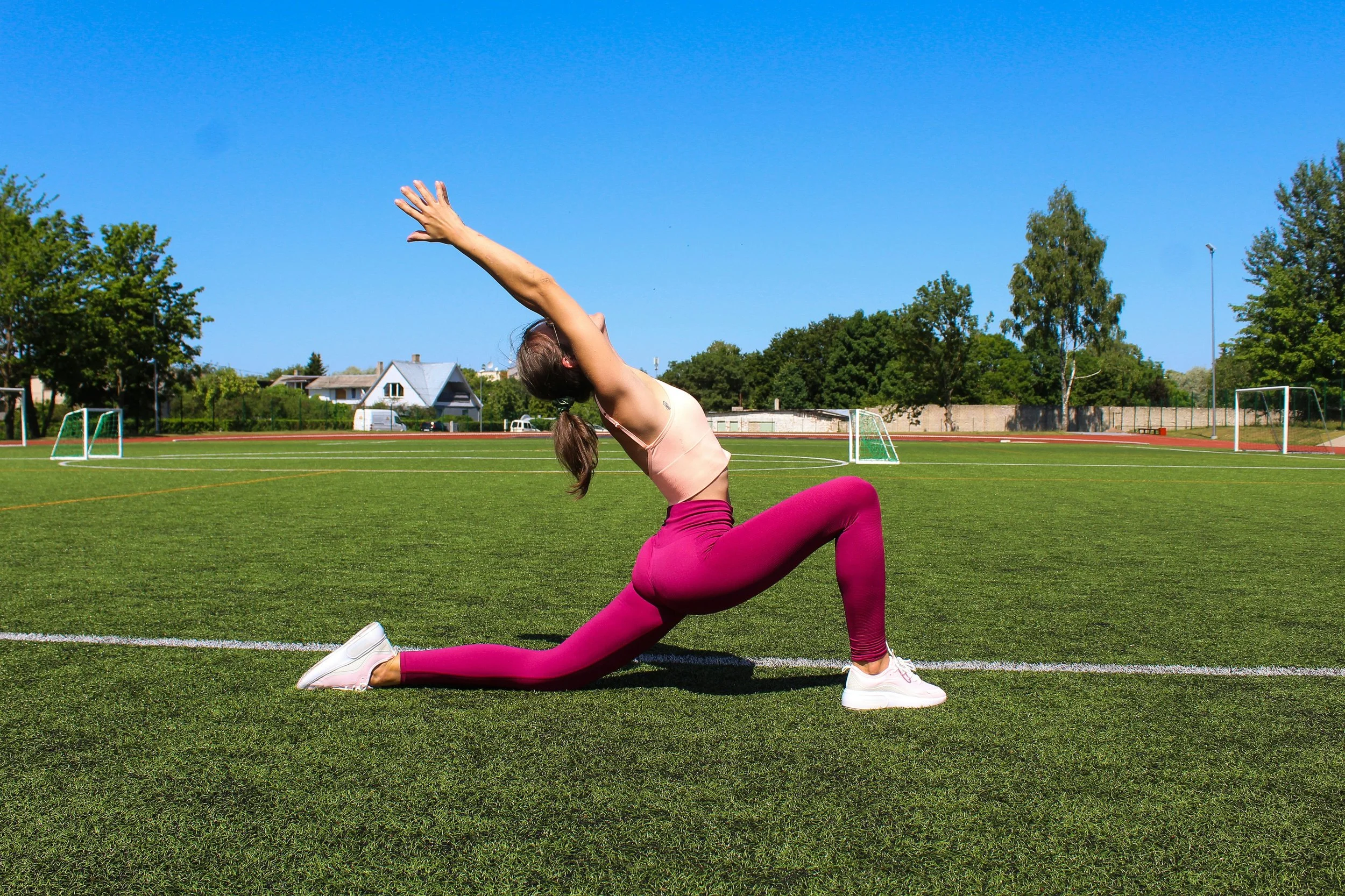
Come into a half-kneeling position with your right knee on the floor and your left foot forward, left knee bent at ninety degrees. Keeping your torso upright and your pelvis neutral, gently shift your weight forward until you feel a stretch in the front of your right hip and thigh. Do not lean forward or arch your lower back as the movement is forward, not downward, and the stretch should be felt deep in the hip flexor rather than in the knee or thigh. Hold it for ninety seconds, then repeat on the other side. Notice whether one side feels significantly tighter than the other as that asymmetry is information.
Standing Against a Wall
Stand with your back flat against a wall, feet hip-width apart and about thirty centimetres from the baseboard. Press your lower back gently into the wall and hold. This neutral pelvic position neither arched nor tucked, is the position in which your psoas is neither shortened nor overstretched, and simply standing in it for five minutes while breathing consciously begins to remind the muscle what neutral actually feels like.
On the Reformer
The reformer addresses your psoas in a way that floor work and standing stretches simply cannot replicate and this is one of the reasons I consider it the single most effective tool available for this particular muscle.
The horizontal position of the reformer removes gravitational compression from the lumbar spine, allowing the psoas to release in a decompressed environment. The resistance provides feedback without force and the platform movement creates a dynamic lengthening of the psoas that is simultaneously active and restorative, strengthening the muscle through its full range of motion rather than simply passively stretching it.
The exercise I return to most consistently for psoas work is the Eve’s Lunge, sometimes called the Kneeling Lunge or the Front Splits prep and here is how to perform it:
Setup
Stand on the floor facing the footbar with one foot placed flat on the footbar, and the other knee bent at approximately ninety degrees, on the carriage pad directly below your hip. The weight is all in your standing foot and the leg is bent. You can rest your hands on the footbar for balance. The resistance should be light to medium.
The Movement
Keeping your torso long and upright, simply lower your hips to the floor and in so doing the platform slides backwards creating a deep lunge position. You will feel the stretch in the front of your back hip, in your psoas and the iliopsoas complex. Extend your standing leg and hold the extended position for 30 seconds, then use abdominals to draw the platform home. The return is as important as the extension — you are not just stretching but actively lengthening and then re-engaging the muscle in a controlled way. after 8 reps rotate your upper body away from the reformer to depend the stretch, return to the front and repeat on the other side.
What to Notice
Pay close attention to any difference between your left and right sides. If the platform moves more freely on one side, if one side feels significantly tighter or more restricted or if one hip drops lower than the other in the lunge position, these are all signs of psoas asymmetry that deserve consistent attention.
Spend an extra two to three repetitions on your tighter side at the end of each set. Over weeks of consistent practice, the asymmetry will reduce and with it the pelvic imbalance, the compensatory spinal patterns and the one-sided back tension that asymmetry produces.
Your psoas will respond to gentle, consistent, regular work far more effectively than to aggressive periodic stretching. Doing this exercise three times per week at moderate resistance produces significantly better results over three months than doing it intensely once a week. The muscle needs to learn a new resting length and that learning happens through repetition, not force.
As your psoas releases and rebalances over weeks of consistent work, you will notice things changing. Your lower back will feel less compressed after sitting and your stride will lengthen and feel more even. The one-sided tension you may have been carrying for years will begin to ease and you may notice an emotional quality to some of the releases; a lightness afterward, an unexpected sense of relief, occasionally a brief wave of emotion that passes as quickly as it arrives.
These are all good signs. Your psoas holds what the rest of your life has been too busy to process and when it releases it takes some of that stored emotion with it.
Your posture will change, your pelvis will sit more evenly and the compensatory patterns that have been rippling upward through your spine will begin to unwind.
One morning you will get up from your desk after an hour and realize that your lower back does not ache the way it used to, your hips feel more open and standing upright feels effortless rather than like something you have to consciously arrange.
That is a morning that is worth every repetition it took to get there.
 written by Marjolein Brugman
Marjolein Brugman is the founder of lighterliving and Aeropilates. “lighterliving is a movement and lifestyle choice we can all make. Let’s make it simple – make one decision a day to be better and watch the small steps lead to big changes. Eat smart, stay active, and you’ll live to feel a lighter life."